



Watchmakers’ benches for schools and training centres
The key points at a glance
The intricate work involved in the Swiss watchmaking industry places high demands on the design of training facilities. By using a modern training bench as a flexible teaching system, it can be quickly adapted to different students. In addition, the combination of ergonomics, robust construction and well-organised media management ensures the quality of basic training for years to come. Forward-looking space planning not only promotes learning success but also sustainably reduces the infrastructure’s operating costs.
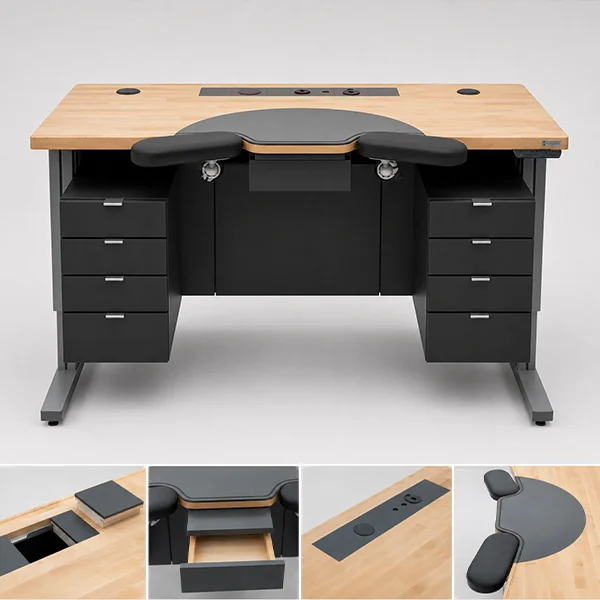
- Multi-user ergonomics: Stepless height adjustment and flexible armrests reduce strain on students during precision work
- Media integration: Fixed connections for lighting, power, compressed air and vacuum keep the work surface organised
- Scalable spaces: A standardised range of workstations is complemented by specialised demonstration or examination workstations
- Investment security: Durable materials and replaceable components ensure reliable long-term availability of spare parts
Why a training watchmaker’s bench must meet its own requirements
Unlike in a manufacturing facility, a watchmaker’s bench in a vocational school or training workshop is not a personal workstation. While professionals in a watch manufacturing facility set up their bench once to suit their own height, training furniture is used by a wide range of different people. For this reason, the adjustment technology must withstand daily repositioning without issue, be intuitive to operate and allow the bench to be quickly set to an ergonomic basic position. Cutting costs in the wrong areas not only risks posture-related strain among students but can also lead to significant time losses at the start of each lesson.
At the same time, a training workshop requires a holistic approach to space planning. Instructors need clear sightlines to the students’ hands so they can observe movements precisely and make corrections directly when necessary. Safe walkways, acoustic separation of noisy auxiliary equipment and a clear distinction between precision and machine zones also make a significant contribution to long-term training success. Structured zoning prevents unnecessary interruptions to workflows and creates a calm environment that supports a high level of concentration.
Ergonomics & health protection in accordance with Swiss standards
Both Suva and SECO provide clear guidelines for precision workstations in Swiss industry. For intricate micro-assembly work, the working height, seating position and armrests must form a harmonious unit to effectively prevent tension in the neck and shoulder area.
Investment security: Durable materials and replaceable components ensure reliable long-term availability of spare parts
Thanks to stepless adjustment ranges, at least 95 percent of all users can easily find a healthy working posture, whether seated or standing. Adjustable 3D or 5D armrests also reduce strain on the shoulder muscles and stabilise the wrists during delicate work at the bench. Clear scales on the adjustment mechanisms allow students to quickly return to their individual settings at the start of each lesson without losing valuable training time.
Visual conditions at the precision workstation
Perfect lighting conditions are the essential foundation for precision craftsmanship in the watchmaking industry. According to official guidelines, illuminance levels of up to 1,000 lux directly on the visual task area are recommended for high-precision work. Dimmable, glare-free task lighting prevents distracting reflections on metallic components, effectively reducing eye strain during prolonged periods of concentration and helping to prevent fatigue.
What requirements must a training bench meet?
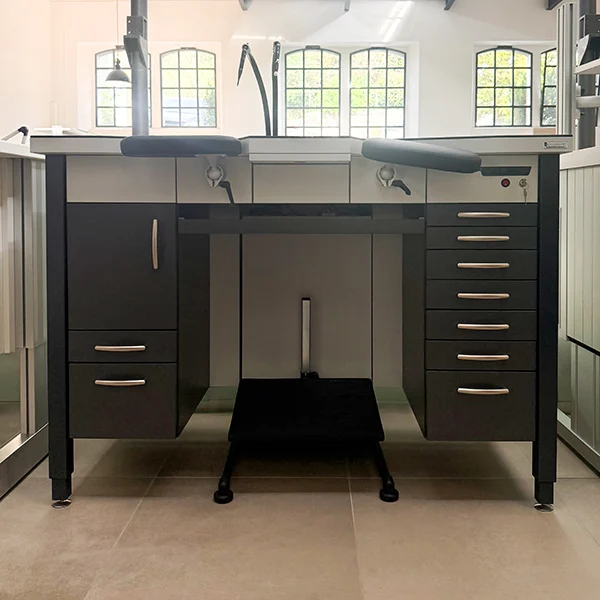
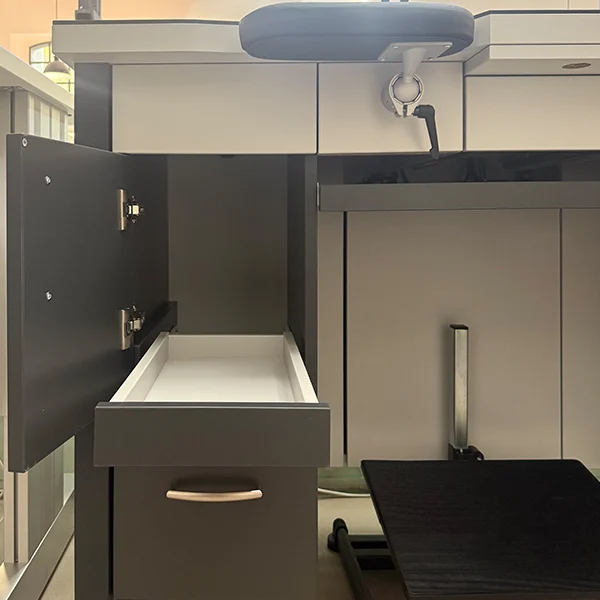
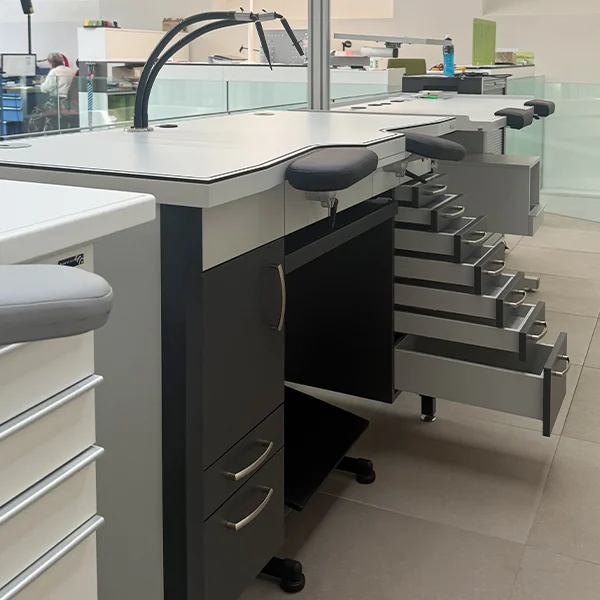
As training furniture is subjected to particularly intensive use in everyday school environments, a high-quality training watchmaker’s bench combines practical functionality with maximum durability.
- Cleanliness and organisation: Smooth, solvent-resistant surfaces make daily cleaning and maintenance easier. Integrated raised edges and protective rims effectively prevent valuable small components from rolling off.
- Integrated utilities: Fixed channels for 230 V power, USB, compressed air and vacuum prevent loose cables on the work surface and significantly reduce the risk of accidents in the workshop.
- Inclusion and flexibility: A modular design allows easy conversion between right- and left-handed use and enables the creation of accessible workstations without significant additional effort.
Model architecture: Standardisation meets customisation
Efficient training facilities are usually based on a modular system that combines proven standards with targeted custom solutions. A well-designed model architecture makes it possible to equip training rooms modularly and expand them flexibly when required.
The modular student workstation
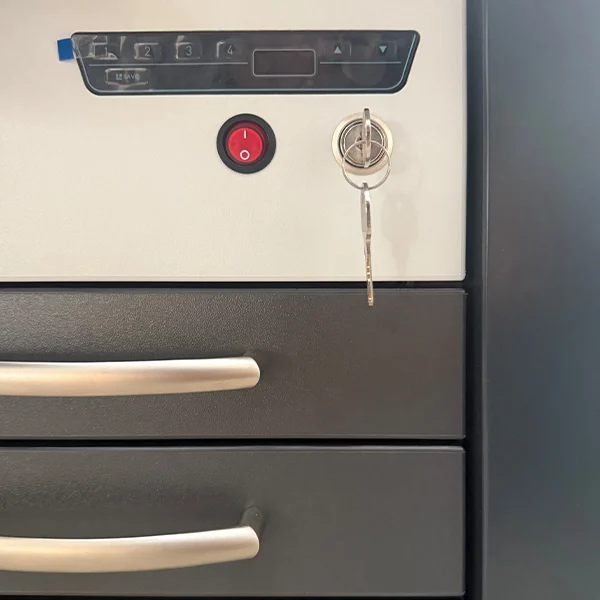
Based on the MODULAR II and MODULAR III model ranges, robust workstations are created for students enrolled in EBA and EFZ training programmes. In addition to electric height adjustment, these workstations offer configurable drawer systems and solid basic equipment for assembly, regulating and inspection work. All controls are designed to withstand frequent daily use without issue.
The instructor and demonstration workstation
Specialised demonstration workstations for instructors can be created based on the UNIQUE MASTER platform. These workstations feature an extended adjustment range, mounts for cameras or monitors, and the option to display work processes directly on screens throughout the training room. This allows all students to follow the instructor’s explanations effortlessly from their own workstations.
Custom-made solutions
Custom-made solutions offer particular advantages when structural space constraints must be accommodated, laminar flowboxes need to be integrated, or examination workstations require a standardised central control system. Rather than developing an entirely new design, high-quality custom solutions are always based on proven core modules. This ensures long-term availability of spare parts and simplifies maintenance for many years to come.
Procurement, total cost of ownership (TCO) & risk minimisation
Instead of focusing solely on the initial purchase price, public procurement and business investment decisions should consider the total lifecycle costs. A seemingly inexpensive workstation can quickly become a costly investment due to expensive spare parts, time-consuming repairs or a lack of long-term availability for replacement components.
- Long-term availability: Schools benefit from modular systems that can be expanded with identical components even years later.
- Maintenance and repair: Wear parts such as armrests or worktop inserts can be replaced individually without having to replace the entire bench.
- Project process: From the initial needs analysis and layout drawings to sample evaluation at the Biel showroom, the planning process follows clearly structured steps.
Checklist: Watchmakers’ benches for training centres/schools
For the evaluation of new watchmakers’ benches for schools, it is worth taking a structured look at all spatial, ergonomic and safety-related requirements. To simplify your internal needs analysis and the preparation of tender documents, we have summarised the most important evaluation criteria in a clear checklist.
Tips for cleaning your watchmaker’s bench
A clean workstation is essential in watch servicing to ensure dust-free assembly processes and flawless micro-assembly. Following a clear cleaning routine protects sensitive tools from contamination, promotes quality awareness among students and helps preserve the value of the workstation infrastructure.
- Duration: Approx. 5 minutes daily at the end of the shift (weekly deep cleaning approx. 15 minutes)
- Practical tip: Print out this routine, laminate it and attach it directly to the watchmaker’s bench. This gives students a useful daily reminder at their workstation. (You can print the checklist as a PDF or provide it as a QR code for scanning.)
- Daily end-of-shift routine: Small components and tools are stored securely in the designated drawer inserts. The work surface is cleared of debris using a soft anti-static brush and then cleaned with a lightly damp microfibre cloth.
- Material-specific surface care: HPL laminate surfaces can be cleaned with mild all-purpose cleaners or isopropyl alcohol solutions. Solid wood worktops should only be wiped with a slightly damp cloth to avoid standing moisture.
- Controls and armrests: High-touch areas such as the leather or synthetic leather padding on the armrests and the buttons for electric height adjustment are cleaned daily to remove skin oils.
- Weekly deep cleaning: Cable management systems, recessed areas and integrated utility channels are checked for dust accumulation. Solid wood worktops are regularly inspected for dryness and re-oiled when necessary.
Designing the ideal workshop setup together
As a specialist in high-quality workshop equipment based in Biel, we work closely with you when setting up, expanding or modernising your training workshop. Our experts support you step by step, from ergonomic analysis and the selection of modular system models to specific adaptations for instruction and demonstration workstations.
You can explore our durable workstation systems in the product overview at https://benchtech.ch/en/watchmaker-benches/. Alternatively, we would be pleased to provide you with personalised advice on site.
FAQs: Frequently asked questions about watchmakers’ benches for schools and training centres
Our Clients















Our Showroom
Experience precision workstations firsthand
Those who wish to compare the differences between the individual models will gain the best impression in the showroom. Materials can be touched, height adjustments can be tested, and technical modules can be experienced firsthand. The visit provides an ideal basis for planning a new workstation or an entire workshop.
Request a visit:
+ 41 58 344 06 00
Contact us
Contact
Administration:
BenchTech Allemann AG
Lettenstrasse 9
CH-6343 Rotkreuz
+41 58 344 06 00
info@benchtech.ch
Showroom:
Visits by arrangement