



The Swiss watch industry sets global standards for quality and craftsmanship excellence. In the workshops, it is decided daily whether this promise can also be kept in after-sales service. An often underestimated factor for the success of this work is the physical workstation. A watchmaker’s bench is not a normal workshop table in miniature format, but a precisely calibrated work tool for the finest tasks. Anyone who applies the wrong criteria here risks quality losses in regulation work and long-term health strain on specialist personnel.
Professional vs. hobby watchmaker’s workbench: Where are the decisive differences?
What distinguishes a high-quality watchmaker’s workbench from a model for hobbyists?
A professional watchmaker’s bench is characterized by a particularly stable construction: the work surface remains stable, straight, and resilient even during fine work under the microscope. In addition, there is an ergonomically well-designed structure as well as a modularly adaptable power and compressed air supply.
Hobby tables or supposedly inexpensive all-purpose alternatives, on the other hand, are usually based on simple standard worktops. They are not up to the specific loads and intensive continuous use, such as in Swiss shift operations. While professional models are specifically developed for precise work on the smallest components, simpler tables lack essential features such as ergonomic armrests, a structured tool zone, or shadow-free light integration.
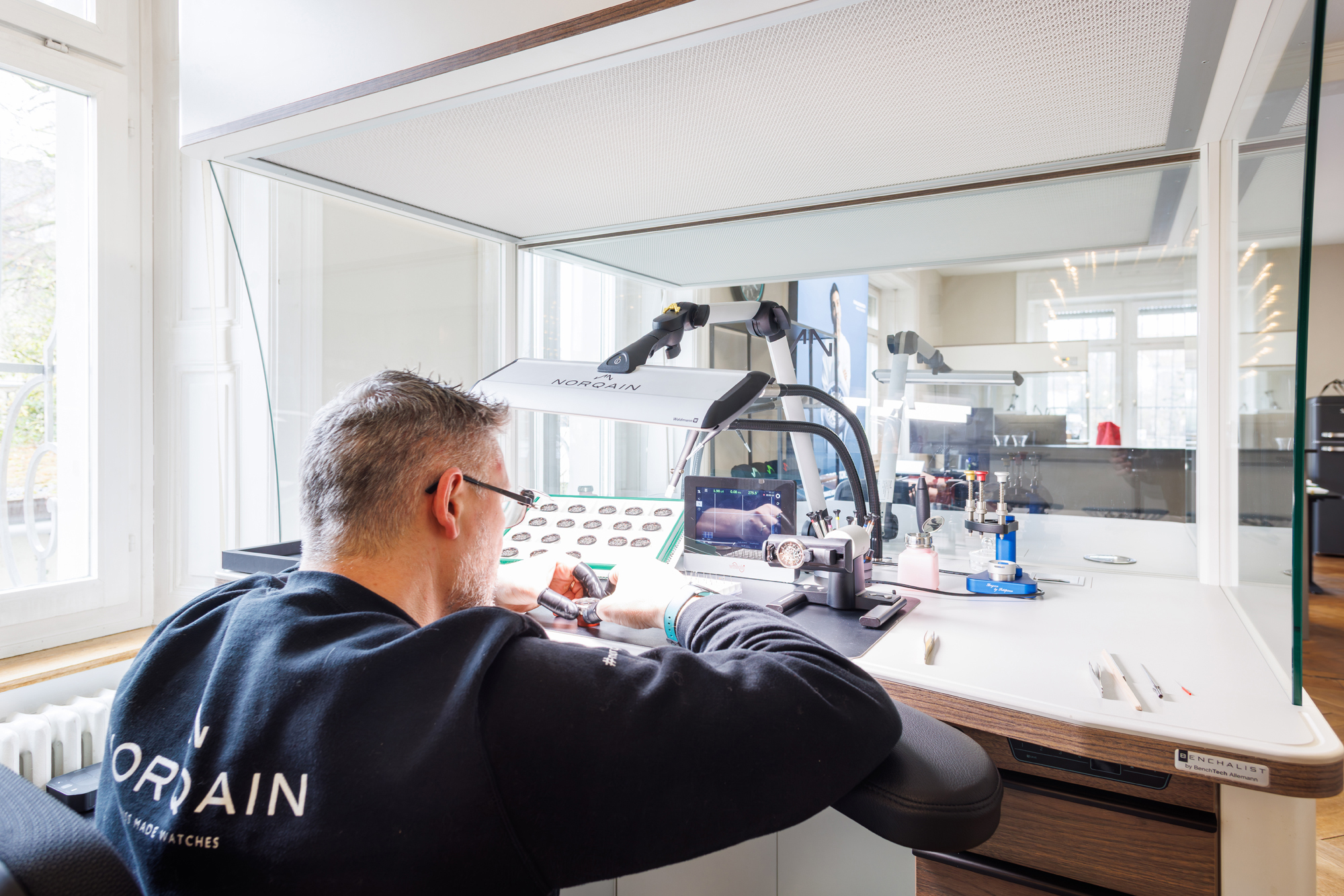
Technical specifications and ergonomics:
- Dimensions according to tool flow: In the specialized market, freestanding watchmaker’s benches with widths of approximately 1220 to 1450 mm and depths of approximately 630 to 700 mm dominate. Compared to wall mounting, this design allows the best combination of legroom, adjustable working height, lateral storage space, and plannable light position. BenchTech offers flexible dimensions with systems such as MODULAR I (width 1200 to 1600 mm, depth 650 to 850 mm), MODULAR II, and MODULAR III, which can be precisely adapted to the space requirements in the workshop.
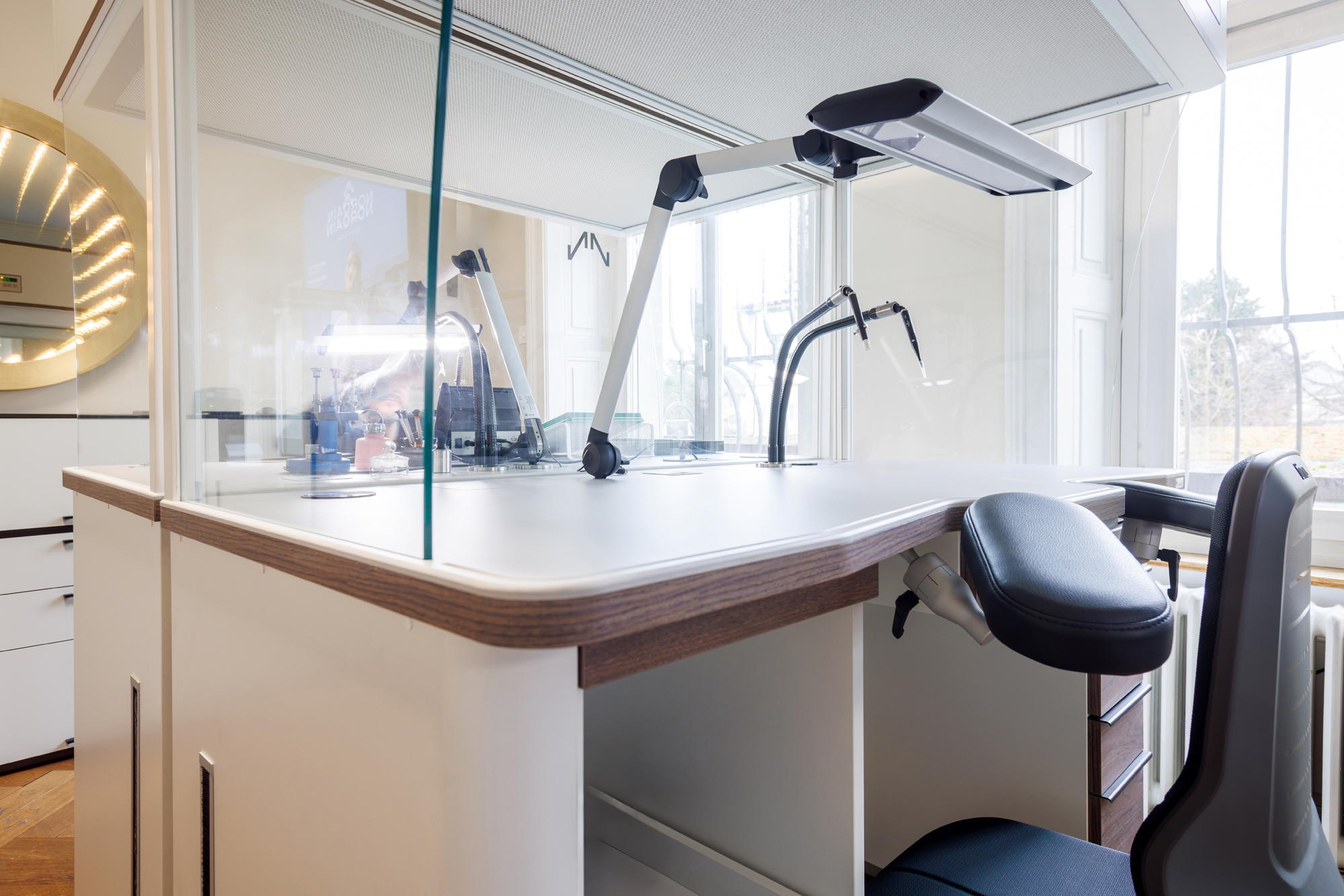
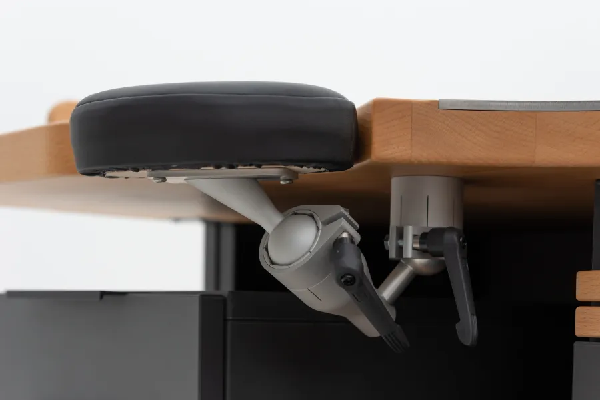
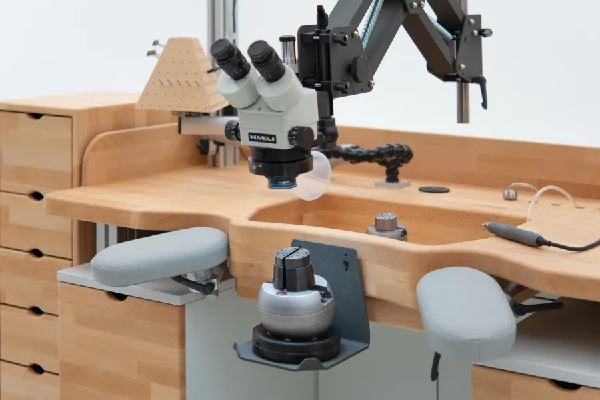
- Ergonomic armrests: During hours of work at the workbench, the forearms must be perfectly supported to prevent muscle tension. Since watchmaking work usually takes place 50 to 150 mm above elbow height, the supports must be sufficiently dimensioned (e.g., 405 x 400 x 20 mm) to effectively relieve the neck. A beveled front edge structures the hand position and enables more fatigue-free work. At BenchTech, customers can choose between permanently integrated, padded armrests or flexible models with 3D ball joints. (Accessories)
- Infrastructure and storage space: A high-quality work table integrates cable channels, power strips, vacuum and compressed air connections directly into the housing to keep the work surface free of cables. BenchTech tables feature a closed rear panel with integrated storage space for electrics as well as milled cable guides with brush seals.
Vibration-free as the foundation of watchmaking
When working with highly sensitive mechanical calibers, every micrometer counts. Vibrations that are invisible to the human eye are transmitted directly to the tool and disrupt the machining process.
How are vibrations reduced at the watchmaker’s workstation?
A professionally planned watchmaker’s bench reduces vibrations through a stable frame construction, precisely adjustable leveling feet, and a solidly constructed work surface. Depending on the application, additional heavy granite or metal plates can be used to further dampen vibrations.
However, a completely vibration-free working environment cannot be guaranteed across the board, as floor, building, and environmental influences also play a role. Air conditioning, traffic, machines, or cleaning equipment can cause vibrations. Therefore, for very sensitive work under the microscope or for image documentation, it should be checked whether a passive or active isolation platform is additionally useful.
BenchTech MODULAR I to MODULAR III rely on a stable four-leg frame made of steel or stainless steel with internal hydraulic cylinders. This allows height adjustment, leveling, and a stable work base to be optimally combined.
Ergonomics and lighting: An overview of swiss standard requirements
Microscope work represents the greatest ergonomic challenge in workshop planning. In addition to body posture, lighting is the critical factor: to avoid interfering reflections on sapphire glass or polished movement plates, strong glare reduction (UGR value ≤ 16) and a high color rendering index (Ra > 90) are essential for fatigue-free work.
In Switzerland, the guidelines of SECO on ArGV 3 as well as the SUVA publications form the legal and practical framework for the design of sitting and standing workstations.
The following table clearly summarizes the legal requirements and the practical values configurable at BenchTech:
| Parameter | Swiss Standard / Guideline | Sensible Practical Target Value | Classification & Relevance |
|---|---|---|---|
| Illuminance | SECO ArGV 3 Art. 15 / ASR A3.4 | At least 1500 lx in the viewing area | 750 lx is considered the legal minimum for fine assembly. Waldmann recommends 1500 lx for watchmakers for color-accurate vision. |
| Glare Reduction & Color Fidelity | DIN EN 12464-1 | UGR ≤ 16 / Prevents interfering reflections on reflective parts. Neutral white light protects the eyes during hours of work. | |
| Working height | SECO ArGV 3 Art. 23 & 24 | 50 to 150 mm above elbow height | Fine work requires a high position. Shoulders must remain relaxed, forearms must be supported. |
| Footrest | SUVA “Sitting or standing” | Height and tilt adjustable | Required as soon as the feet do not rest fully due to high sitting position (seat height 420–590 mm). |
| ESD protection | IEC 61340-5-1 | Controlled discharge via EPA | Mandatory for quartz movements, circuit boards, and electronic diagnostics. |
The BenchTech purchasing checklist: Finding the right watchmaker’s workbench
Use these five core criteria to systematically check the suitability of a watchmaker’s bench for your service center before purchase:
Practical tip: In Switzerland, personal relationships and trust count more than sheer volume. In our many years of practice, we have seen that individually planned workstation solutions and precise coordination with the workflows of each workshop deliver the most reliable results.
A bench must adapt to the watchmaker, not the other way around!
As a specialist for high-quality workshop equipment in the heart of the Swiss watch industry, we support you in planning and implementing custom workstation concepts. If you want to establish ergonomics and precision in your workshop on a new foundation, we are happy to accompany you from the initial analysis to final installation and beyond.
Let us examine together how you can optimally use the space in your service center/workshop and noticeably improve the ergonomics of your workstations.
Discover the complete watchmaker’s bench range from BenchTech Allemann AG and receive non-binding advice from our experts in Biel.
FAQs: Questions and answers on the topic of watchmaker’s workbench
Our Clients















Our Showroom
Experience precision workstations firsthand
Those who wish to compare the differences between the individual models will gain the best impression in the showroom. Materials can be touched, height adjustments can be tested, and technical modules can be experienced firsthand. The visit provides an ideal basis for planning a new workstation or an entire workshop.
Request a visit:
+ 41 58 344 06 00
Contact us
Contact
Administration:
BenchTech Allemann AG
Lettenstrasse 9
CH-6343 Rotkreuz
+41 58 344 06 00
info@benchtech.ch
Showroom:
Visits by arrangement